


Summary
Cohort analysis software enables organizations to comprehend user behavior within different cohorts. In this guide, we have highlighted 8 of the best cohort analysis software available in 2026. These include Amplitude, Mixpanel, GA4, PostHog, Heap, Pendo, Matomo, and Tableau.
One of the most useful approaches in increasing retention, engagement, and revenue is understanding how users behave over time. While traditional analytics will show you how many people used your site or bought some products, cohort analysis is able to provide information about what happens with certain user groups who took a certain action.
For instance, you could analyze the behavior of clients who registered in January and compare it to the behavior of the group that registered in February to find out which of these two groups was more active. In addition, it is possible to define behavioral cohorts according to different actions like completing the onboarding process, buying a certain product, using some feature, etc. Cohort analysis tools in 2026 are not a problem for businesses. The problem is to find the right tool that would not complicate and overload your work too much.
What Is Cohort Analysis Software?
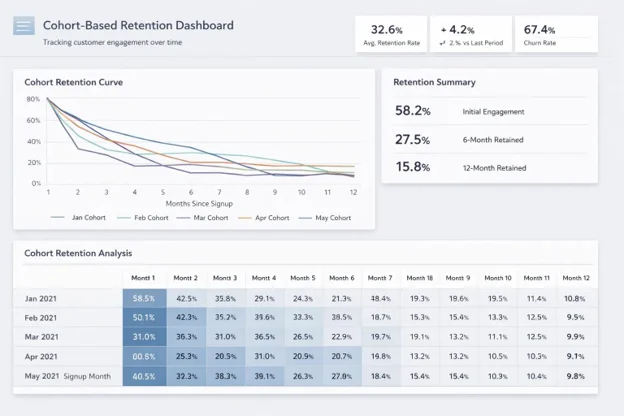
Cohort analysis is software that will place people into different groups on the basis of a common factor and analyze their activity. Cohorts can be formed based on the following:
- Date of sign-up or acquisition
- Date of purchase
- Marketing campaign
- Subscription package
- Location
- Usage of a product or feature
- Lifetime value of a customer
- Level of engagement
Today, there are more advanced features of analytics that are not limited to just using dates in forming cohorts. Behavior-driven cohorts allow businesses to categorize people according to what they are doing within a website or application.
Why Use Cohort Analysis Software?
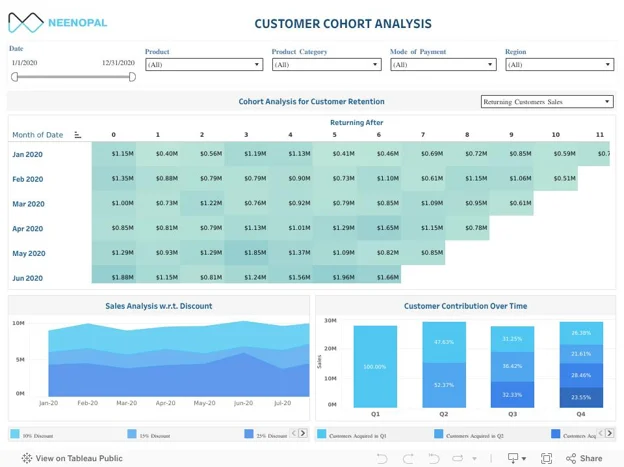
Manual generation of cohorts using spreadsheets may work in case of limited data, but it gets very complex with increasing numbers of customers and events. Cohort analysis tools may assist you in:
- Measuring retention rate of customers
- Finding high-value segments of users
- Understanding churn rates
- Comparing different acquisition channels
- Analyzing product usage
- Measuring engagement with features
- Measuring the effectiveness of marketing campaigns
- Understanding behavioral trends
- Increasing the lifetime value of customers
- Making data-driven decisions related to product development
The best tools additionally enable linking of cohort analysis with experimentation, messaging, product engagement, etc.
8 Best Cohort Analysis Software in 2026
1. Amplitude
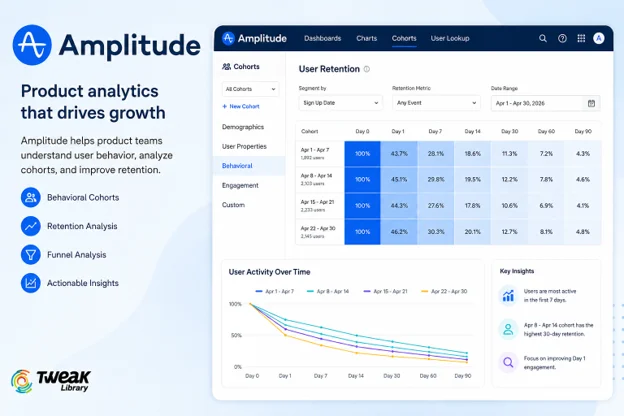
Amplitude is one of the best solutions for product teams needing sophisticated behavioral cohort analysis. The analytics solution allows you to create your cohorts according to certain actions or a chain of actions and analyze their retention, conversion, engagement, and other metrics.
One of the main advantages of Amplitude is the ability to use cohort analysis for more than just reports; teams are able to apply insights from analysis through experimentation and product engagement processes.
Main features:
- Behavioral cohort analysis
- Retention analysis
- Segmentation by events
- Funnel analysis
- Product analytics
- Experiments
- Product engagement
- AI-driven analytics capabilities
Best for: Product and growth teams needing sophisticated behavioral analytics.
- Good cohort abilities
- Great segmentation abilities
- Good retention abilities
- Best suited for product-based businesses
- The advanced features may be difficult to learn
- Cost increases with increased usage and needs
2. Mixpanel
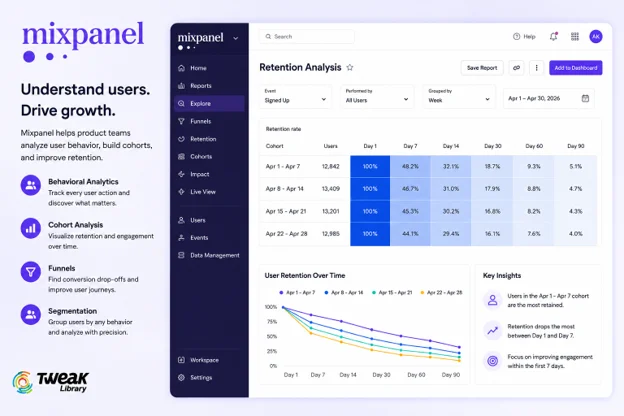
Mixpanel is one of the well-known product analytics solutions that makes event analytics easy to use for product managers and teams involved in growth. The tool’s cohort builder lets you segment users based on their behavior and study how these groups use your product. Behavioral cohorts, retention analysis, funnels, segmentation, and user behavior analysis are just some of its features.
Main features:
- Behavioral cohorts
- Retention reports
- Funnels
- Event tracking
- User segmentation
- Product analytics
- Interactive dashboards
Best for: Those who seek a user-friendly product analytics solution.
- Easy to use
- Great event analytics
- Efficient retention reports
- Suitable for product managers
- Pricing depends on usage
- Some advanced workflows require more tools
Also Read: Best MailChimp Alternatives
3. Google Analytics 4
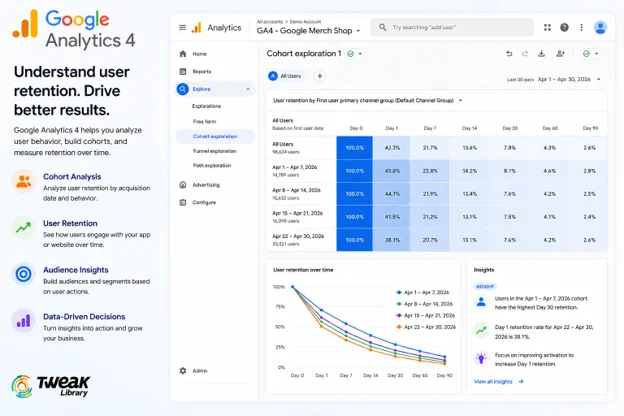
Another free solution for companies that need cohort and retention analysis is Google Analytics 4 (GA4). GA4 allows creating cohorts based on acquisition and analyzing retention and engagement rates. It is a popular analytics tool that many businesses use to monitor website and application performance. Thus, the most significant advantage of using GA4 is its accessibility and affordability. Still, if teams are seeking advanced behavioral cohort analysis tools, then some dedicated product analytics solutions may be more relevant at some point.
Main features:
- Acquisition cohorts
- Retention analysis
- Web analytics
- Mobile app analytics
- Events tracking
- Audiences segmentation
- Marketing attribution
Best for: small businesses, marketers, and companies that are mainly concerned with web/app analytics.
- Free
- Excellent marketing analytics
- Works for both web and mobile platforms
- Limited behavior cohorts functionality
- More suited for marketing than for product analytics
4. PostHog
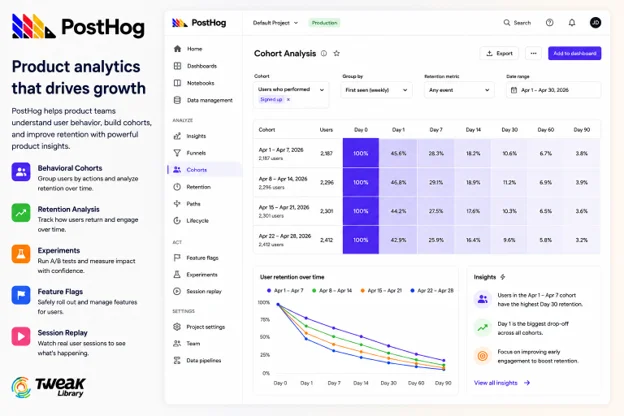
PostHog is especially suited for engineering-first teams who would like to have product analytics along with various other development and experimentation tools. PostHog offers behavioral analytics, as well as session replay, feature flags, experimentation, and product insights. Another notable feature is that PostHog offers self-hosting options, which could be desirable for teams seeking to have more control over their data and infrastructure.
Main Features:
- Behavioral cohorts
- Retention
- Session replay
- Feature flags
- A/B testing
- Product analytics
- Self-hosting
Best for: Startups looking for everything from one tool.
- Comprehensive set of features
- Self-hosting available
- High developer-centricity
- Combines analytics and experiments
- Might require some technical expertise
- Self-hosting requires maintenance
5. Heap
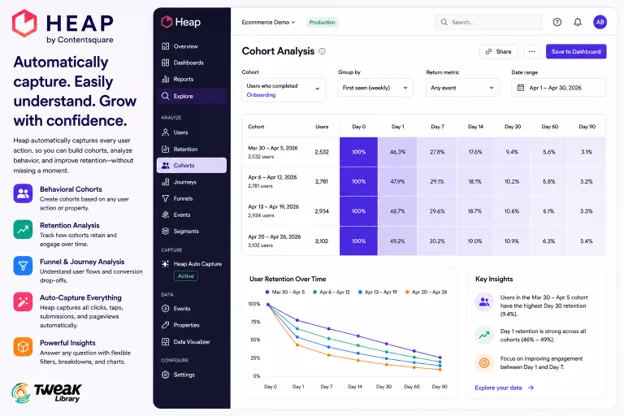
Heap uses the technique of automatic event capturing. Unlike traditional tools that need to know what interactions are going to happen before collecting data, Heap can automatically collect a number of user interactions. This works great for cohort analysis because you can analyze behaviors after the data collection is completed. You might find a user behavior that will be very useful for you to create a cohort even though you did not plan it several months ago.
Main Features:
- Automatic event capturing
- Behavioral cohorts
- Retention analysis
- Segmentation
- Product analytics
- Journey analysis
Best for: Teams that require flexible analysis but do not have to plan events beforehand.
- Data is automatically captured
- Works well for retroactive analysis
- Provides a lot of behavioral information
- Reduces manual instrumenting
- Automatically captured data is noisy
- Needs proper data governance
6. Pendo
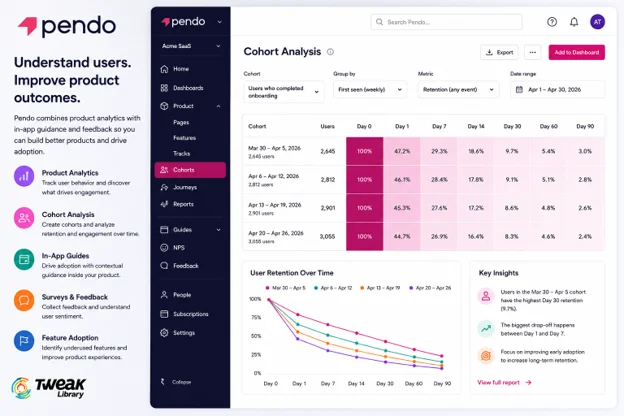
Pendo combines product analytics with in-app guides, surveys, and user engagement capabilities. Its cohort capabilities could help companies identify their users’ segments and learn about how they use a product. However, its true value will emerge once insights obtained through analysis and monitoring become an opportunity to improve onboarding, feature adoption, or in-app communication.
Main Features:
- User Segmentation
- Cohort Analysis
- Product Analytics
- In-app Guides
- Surveys
- Feature Adoption Tracking
- Product Feedback
Best for: Product Teams who need both product analytics and user engagement capabilities.
- Both analytics and engagement on one platform
- Great onboarding capabilities
- Suitable for feature adoption
- Built for product teams
- Not as powerful in cohort analysis as analytics platforms
- Advanced capabilities might be relevant to larger organizations only
7. Matomo
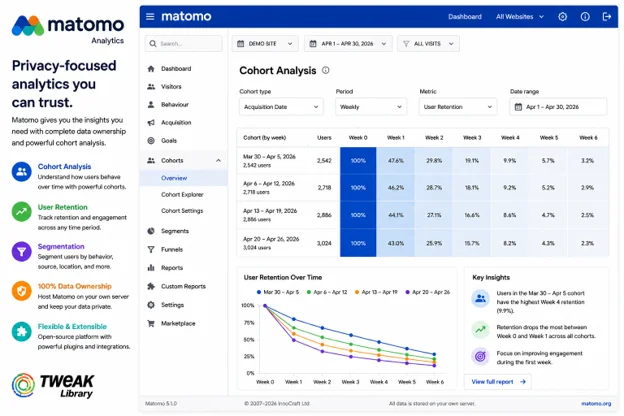
Privacy-first analytics tool that is suited for organizations or companies who would like to have more control over their analytics data. The product offers cohort reporting and web analytics, while being open-source and offering self-hosting makes it appealing for organizations with high demands on privacy or data ownership. Matomo is a great choice if data sovereignty is one of the priorities.
Main Features:
- Cohort reporting
- Web analytics
- User segmentation
- Conversion tracking
- Privacy-first analytics
- Self-hosting
Best for: Privacy-first organizations and companies who want to have control over analytics data.
- Privacy-first approach
- Self-hosting available
- Data ownership
- Open-source
- Needs more configuration compared to other cloud-based analytics solutions
- Not as powerful in behavioral analytics as product analytics tools
8. Tableau
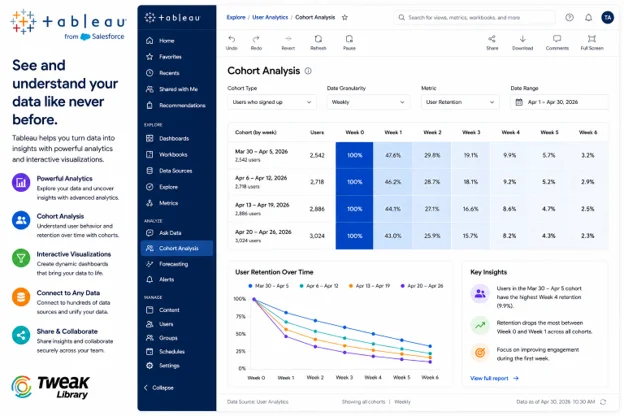
Tableau follows a completely different methodology in cohort analysis. Tableau is not a product analytics tool but rather a business intelligence and visualization tool which can be used for designing custom cohort reports from modeled data.
This makes Tableau very suitable for those companies that have a data warehouse and a BI setup in place. Data teams can use the platform to design their own retention tables and dashboards based on business-specific cohorts.
Main Features:
- Custom dashboards
- Data visualization
- Cohort reports
- Business intelligence
- Data warehouse integration
- Reporting
Best for: Companies needing customized cohort reporting solutions.
- Highly customizable visualization options
- Robust business intelligence tools
- Suitable for customized reporting
- Well-suited for warehouse-based data
- Needs data modeling
- Needs knowledge of SQL
- Not specifically built for behavioral cohorts
Conclusion – Which Cohort Analysis Software Should You Choose?
There is no universal winner because the right tool always depends on your needs.
Amplitude is great for product teams who require complex behavioral cohorts and retention. Mixpanel would be the right choice for teams that value the user-friendly interface of the analytics tool. For those who don’t require complex behavior cohorts, Google Analytics 4 is the right tool to go with.
In case you have a technical team and need session replay, feature flagging, and experimentation along with analytics, PostHog should be considered. Heap would be a good choice for those who value automatic event capturing. Pendo could be considered in case you need in-app engagement together with analytics.
For privacy-driven businesses, Matomo would be the right choice. In case of a business intelligence team, which already has structured data in their data warehouse, Tableau is the right tool.
At the end of the day, the best cohort analysis tool would be the one that would help your team to answer the following question: what are our most important users doing differently,y and how can we change this?






Leave a Reply