


Summary
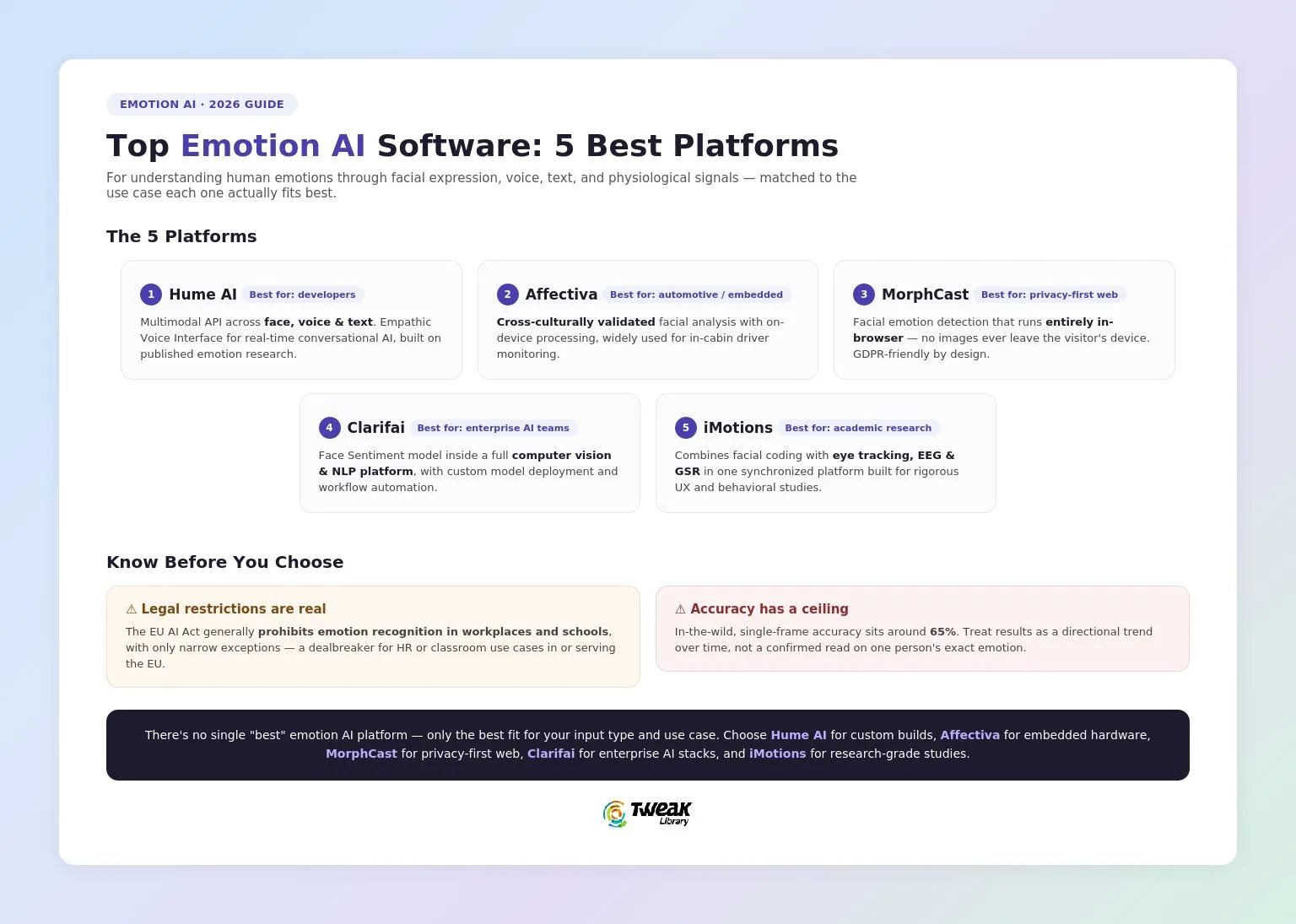
This article covers 5 leading Emotion AI platforms – Hume AI for developers, Affectiva for automotive, MorphCast for privacy-first web, Clarifai for enterprise AI, and iMotions for research – plus two often-overlooked limitations: EU AI Act restrictions on workplace/school use and a real ~65% accuracy ceiling.
Emotion AI, also called affective computing, is AI software that tries to read human emotions from faces, voices, text, or a mix of all three. Among the fastest growing areas of Applied AI today, emotion AI has already been incorporated into applications such as customer service, healthcare, automotive, education and marketing research but it’s also one of the easiest to pick wrong, since the best platform for reading facial expressions in a car isn’t the same as the best one for analyzing voice tone in a call center. Here are five leading platforms, each built around a genuinely different strength, and what to know before choosing any of them.
What Is Emotion AI
Emotion AI applies machine learning to analyze and understand human emotions that are expressed in the form of facial expressions, tone of voice, written text, or physiological signals like heart rate. The main goal is to recognize the emotional state of an individual, rather than simply whether they have a positive or negative sentiment toward a particular subject. It also attempts to capture how the emotional state changes with time. The output typically comes as sentiment scores, emotion labels, or visual dashboards, delivered through an API, SDK, or a fully hosted platform depending on the tool.
The 5 Best Emotion AI Platforms
1. Hume AI
Hume AI provides a multimodal emotion AI platform based upon research that examines how humans express and perceive many different emotional dimensions, far beyond the typical happy or sad classifications. The Hume AI platform has the ability to analyze facial expressions, voice, and language simultaneously through a developer-facing API, with an Empathic Voice Interface specifically designed for use in real-time conversational AI applications.
It earns its place here because of its consistency in being selected by the greatest number of product development teams that are developing emotion-aware products from scratch rather than buying pre-built packaged dashboard, and its research-backed emotional taxonomy goes noticeably deeper than most competitors’ basic emotion categories.
Key features: facial, voice, and text emotion detection; empathic voice interface for conversational AI; API-first delivery; research-validated emotional taxonomy.
Best for: developers building emotion-aware applications, particularly conversational AI and mental wellness tools.
2. Affectiva (Smart Eye)
Affectiva, now part of Smart Eye, is a facial and in-cabin emotion analysis platform with roots in over a decade of research into emotions and includes a large dataset of facial expressions. It is especially strong in the automotive industry where sensing inside the vehicle monitors driver alertness and emotional state for safety systems.
It is included within this list because of the largely missing category of cross culturally verified facial recognition software developed for on-board vehicle usage rather than a purely cloud-based dashboard.
Key features: facial expression and in-cabin emotion analysis; cross-cultural validation at scale; on-device processing options; automotive safety integrations.
Best for: automotive and embedded hardware applications needing validated, on-device facial analysis.
3. MorphCast
MorphCast is a browser-based emotion AI platform which analyzes visitors’ facial expressions using the computer solely as a processing device; images and videos are never transmitted to a remote server. MorphCast is one of the very few true “privacy first” solutions available in the category, built specifically for GDPR-sensitive use cases like interactive web content and marketing.
It has earned its spot due to how most emotion AI tools will use your private information in exchange for functionality that you can obtain with MorphCast by exchanging some of the capabilities for an on-device, in-browser privacy model that is compliant with GDPR.
Key features: fully on-device, in-browser facial processing; no data leaves the visitor’s device; GDPR-oriented compliance design; real-time content adaptation.
Best for: marketing and web teams needing privacy-compliant, real-time emotion detection without server-side data handling.
4. Clarifai
Clarifai is an enterprise AI platform built around computer vision, natural language processing, and audio analysis, with a Face Sentiment model that detects emotion from facial expressions as one piece of a much larger AI development suite. However, beyond the specific use case of emotion detection, Clarifai also supports users in creating their own models, data annotation, and automating workflows across the entire lifecycle of developing other types of AI applications.
It earns its place here as the strongest pick for teams that need emotion recognition as one capability inside a larger, already-adopted enterprise AI platform, rather than a single-purpose emotion tool.

Key features: face sentiment and facial detection; broader computer vision and NLP APIs; custom model deployment; enterprise workflow automation.
Best for: organizations already building on a broader AI platform that also need emotion recognition capability.
5. iMotions
iMotions is a research-grade platform that combines Affectiva’s facial coding with eye tracking, EEG, and galvanic skin response (GSR) sensors in a single, integrated study environment. This tool is designed for both UX Research and Academic or Research purposes; allowing researchers to collect all biometric information into one synchronized dataset.
It earns its place here as the clear leader because it is the most robust platform for conducting rigorous, multi-signal research. None of the other platforms listed above can provide the same level of research capabilities as the current one, as all of them were designed to be used for production rather than research.

Key features: multimodal biometric integration (facial, eye tracking, EEG, GSR); synchronized multi-sensor data collection; academic and UX research tooling; detailed study design support.
Best for: academic researchers and UX teams running rigorous, multi-signal emotion and attention studies.
Important Limitations to Know Before You Choose
Two features of the best emotion AIs almost never get talked about, but they are likely to be way more important than how well each model compares individually. First, legal restrictions are real and growing: the EU AI Act generally prohibits emotion recognition in workplaces and educational institutions, with only narrow exceptions, which rules out entire use cases for organizations operating in or serving the EU.
The second is that accuracy does have limits – according to various independent assessments, the maximum achievable accuracy from an emotion AI tool for classifying a person’s emotions from a single frame is approximately 65%, meaning these tools are far more reliable for aggregate trends, like engagement or valence over a session, than for a confident read on one person’s exact emotional state at one exact moment.
Frequently Asked Questions
The bottom line
There is no best AI platform for emotions overall; there is only the best fit for specific input types and use cases: Hume AI for developers building from scratch directly, Affectiva for automotive and embedded hardware, MorphCast for privacy focused browser apps, Clarifai for teams already on broader AI platforms and iMotions for rigorous multi singnal research. Whichever you choose, treat the technology’s real accuracy ceiling and the EU AI Act’s restrictions on workplace and school use as seriously as any feature comparison.




Leave a Reply