


Summary
AI agents are artificially intelligent software programs that can define goals, plan, employ tools, make decisions, and act independently to a significant extent without human interference. AI agents find their application in research, productivity, coding, customer service, business processes automation, etc., in 2026.
AI has gone well past its ability to answer queries and generate content. The future of 2026 will see AI agents, a kind of system that goes well past just responding to prompts but can help plan actions, use tools, make decisions, and act on behalf of the user.
Whereas the typical AI chatbot will be able to advise you on planning a trip, the AI agent will be able to do all this research, comparison, availability check, planning of the itinerary, and more with far less human involvement.
From AI that simply answers to AI that acts makes this technology increasingly relevant for people and businesses alike. But how is an AI agent defined, how does it work, and how can you leverage it in 2026? Let’s learn more.
What Is an AI Agent?
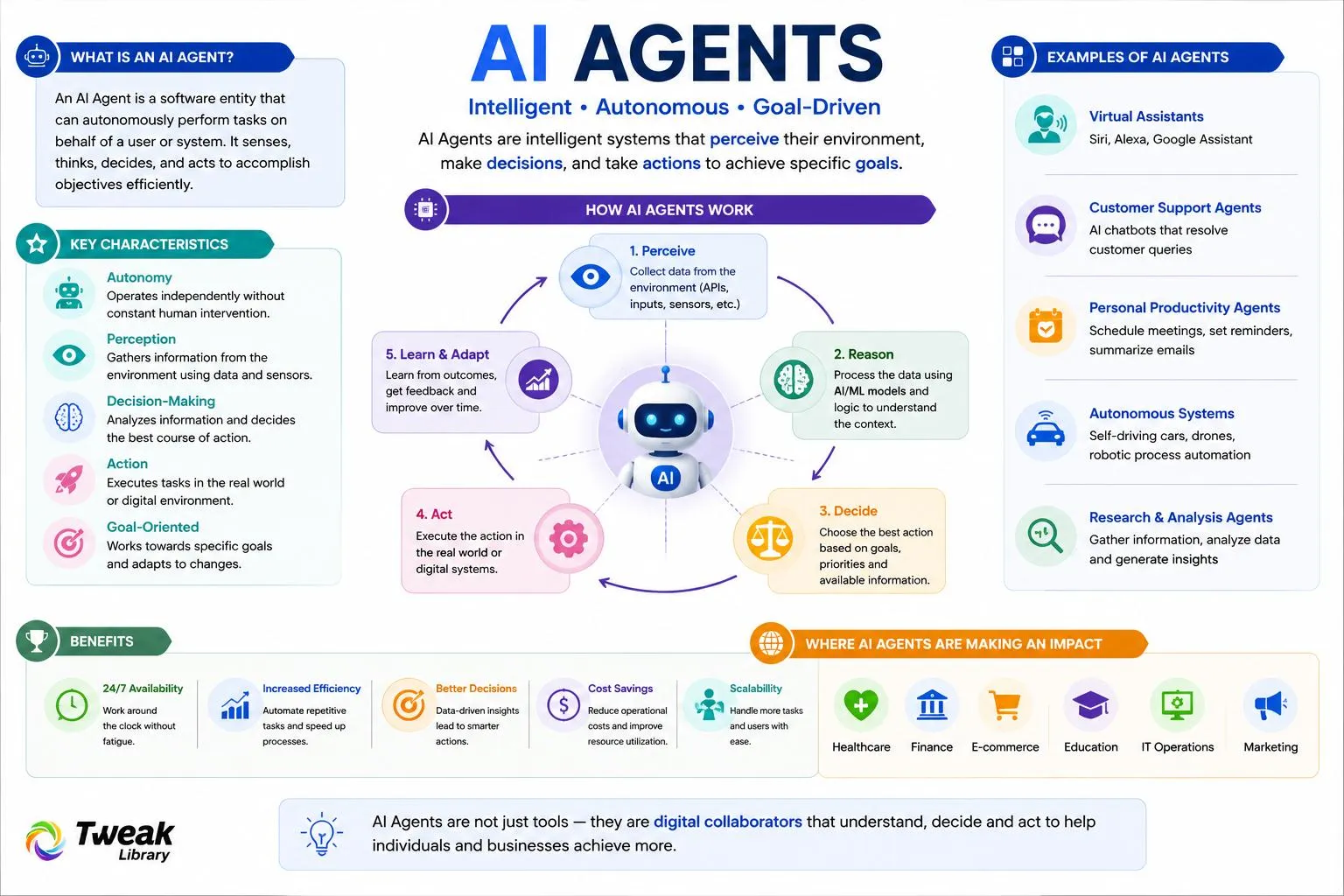
AI Agent is an artificial intelligence program which implements artificial intelligence techniques and achieves some goal through performing tasks by itself.
In contrast to a traditional chatbot, which usually responds to a command, an AI agent can divide a particular task into smaller sub-tasks, determine what should be done, apply various tools, assess the outcome, and repeat the process until the task is accomplished or human intervention is needed.
According to Google, AI agents are able to perform reasoning, planning, remembering, deciding and applying tools.
How Do AI Agents Work?
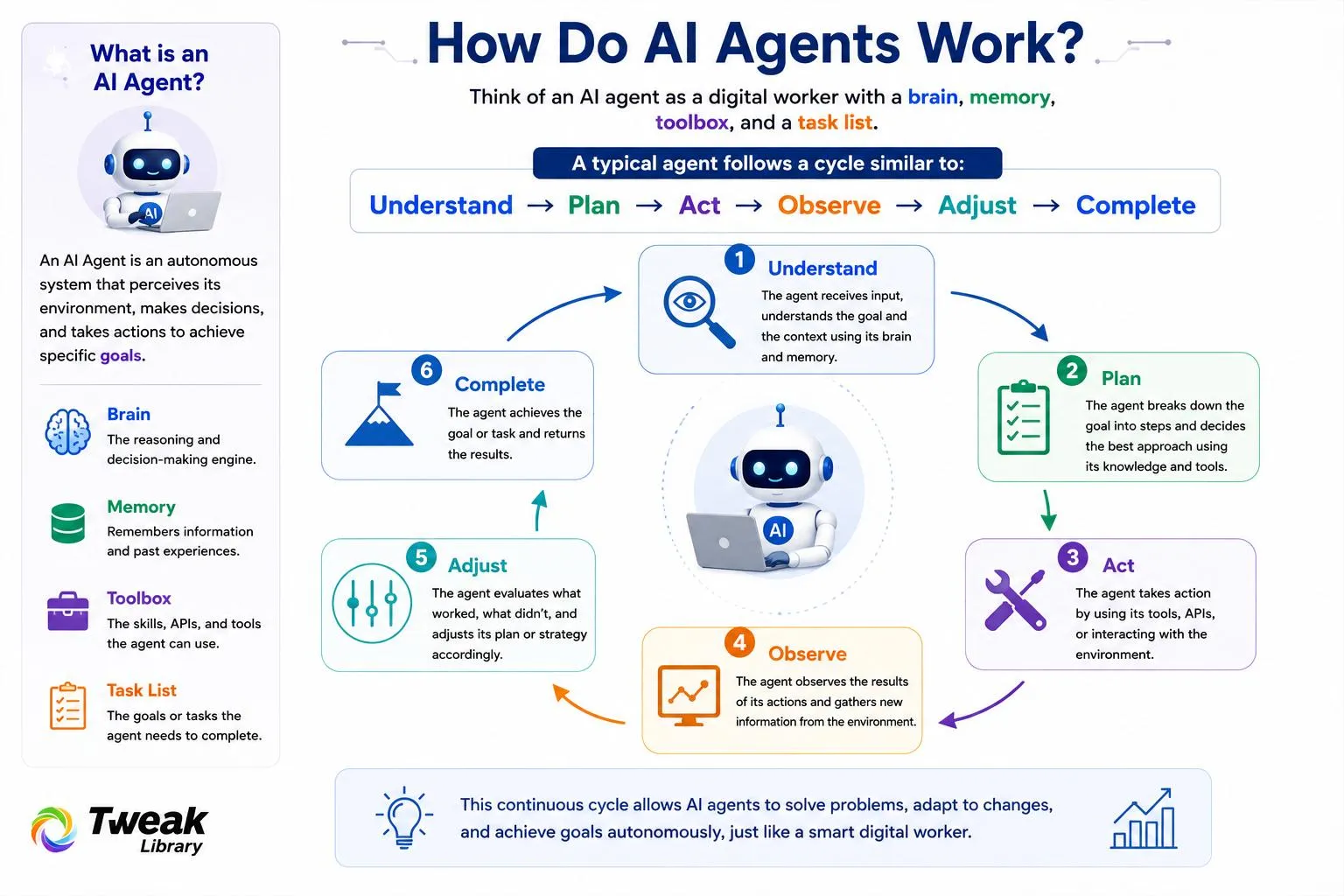
Imagine an artificial intelligence agent as a computer program that has a brain, memory, a toolkit, and a list of jobs to do.
A usual agent goes through a process which is close to “Understand – Plan – Act – Observe – Improve – Finish” one. And here is how it all works.
- The Agent Understands the Goal
All the processes begin with the goal-setting. The agent comprehends what the user wants and what he is supposed to get.
- It Develops the Strategy
Rather than performing everything at once, the agent may break down the task into actions. The ability to plan is what makes the main distinction between AI generation and agents.
- It Uses Tools
The AI model alone is unable to instantly connect with all kinds of applications and do all sorts of actions in the physical world. An agent becomes meaningful by linking the AI model with tools. These tools could include Web search, Databases, APIs, Email, Calendars and Business Applications. The tools actually provide the agent with hands and feet. Google lists tools, models, memory, orchestration, grounding, and runtime as critical elements for modern agent systems.
- It Observes the Result
After taking an action, the agent studies the result. In case of failure, the agent might change its strategy and undertake some other action.
- The Agent Recalls from Memory
The use of memory helps the agent retain information across multiple communications.
- The Agent Performs an Action
Lastly, the agent executes the necessary action. Based on its access rights, it can either create documents, edit spreadsheets, send a message, analyze information, among other software actions.
What Can AI Agents Do in 2026?
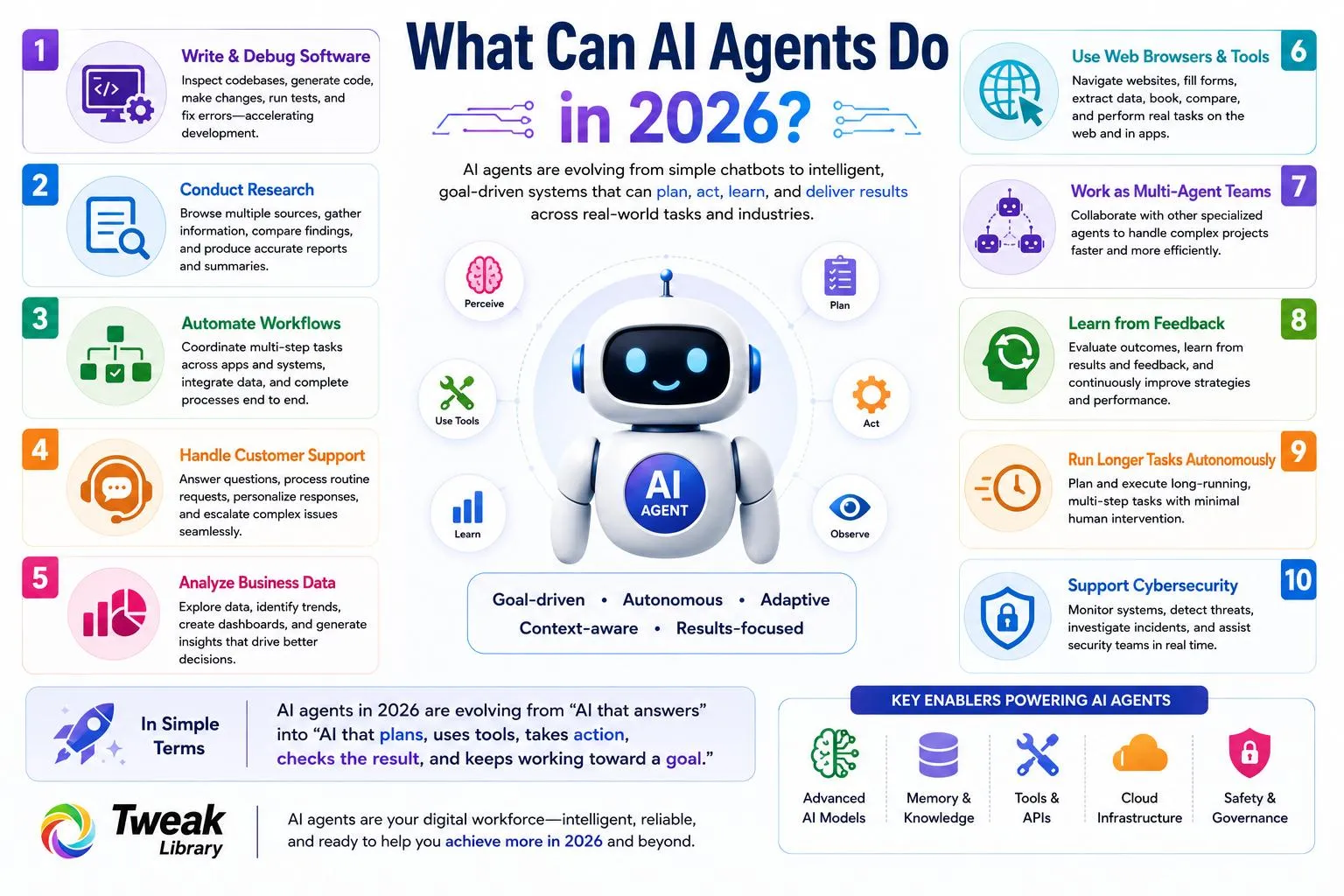
AI agents are currently being tested out for many different applications.
Personal Productivity
The personal AI agent will be useful for handling repetitive activities like:
- Information organization
- Document summarization
- Schedule management
- Preparation of meeting notes
- Task list preparation
- Research on different subjects
Research
Researchers can collect information from various sources, compare the data, consolidate it into summaries and present the findings in a report format.This is especially helpful if the assignment includes many little research tasks to complete.
Software Development
Programmers can deal with programming language syntax, debug code, write code, edit code, test and repeat after analyzing the test results. Rather than asking an AI to code a single function, developers can provide programming goals to agents for increasingly complex software development.
Customer Support
The use of an AI agent for customer support involves the ability to understand customers’ queries, access customer data, search knowledge databases, troubleshoot issues, and escalate complicated cases to human representatives.
Business Process Automation
Businesses may make use of the agents to link several different applications and automate business processes that involve activities such as sales, marketing, finance, HR, customer service, and other processes.
How to Use AI Agents in 2026
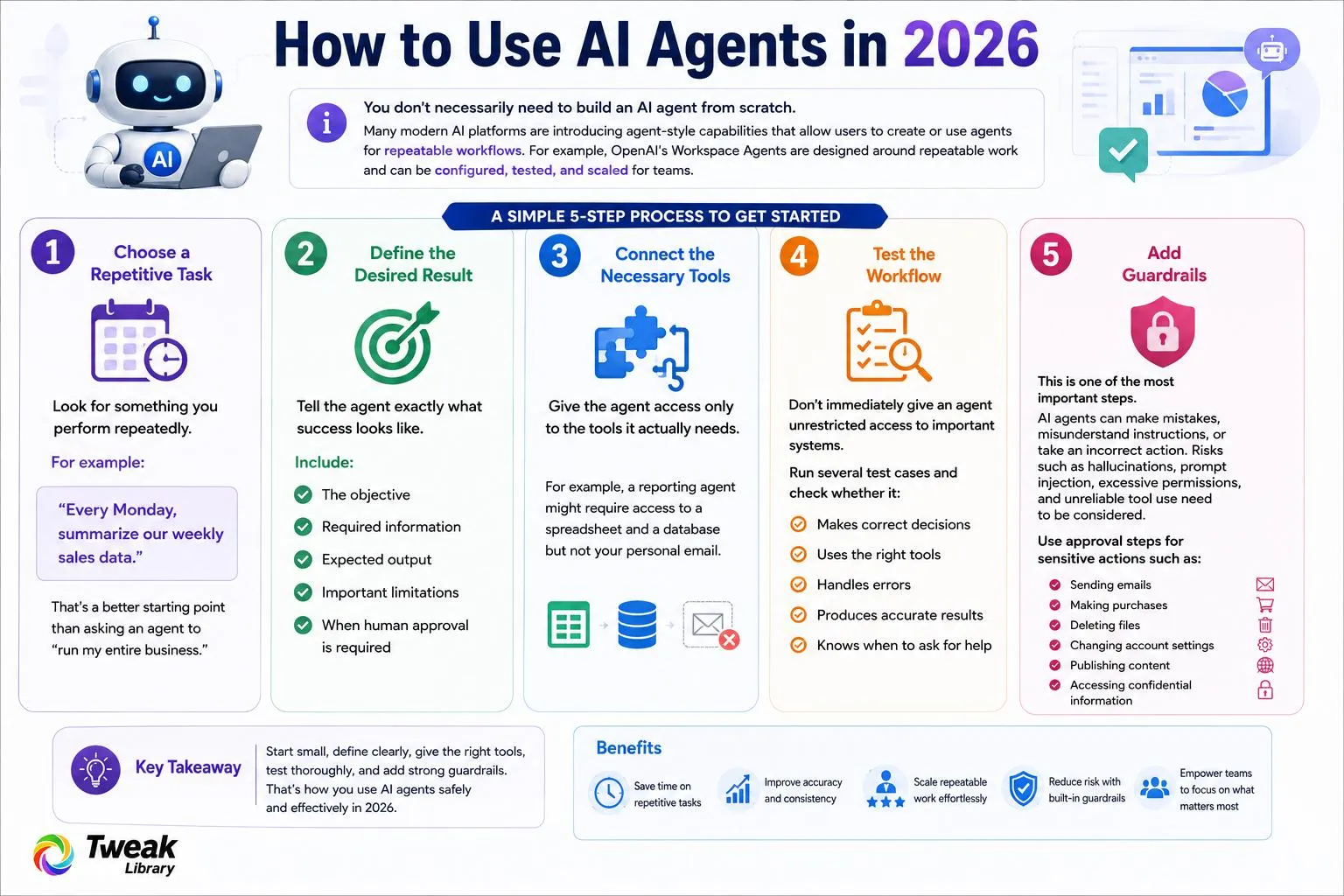
Several modern AI platforms are coming up with agent-based features that enable users to build or operate agents in repeatable processes. One such platform is the Workspace Agents of OpenAI, which is based on repeatable work and is customizable, testable, and scalable to be used by teams. Below is one way to do it.
Step 1: Identify Repetitive Work
Identify any work that you do repeatedly.
Step 2: Determine Expected Outcome
Inform the agent what is expected of it in clear terms. Include Objective, Required information, Expected Output, Important Constraints. If Human Approval is needed
Step 3: Integrate Relevant Tools
Grant access to the agent only to the tools that are needed.
Step 4: Test the Workflow
Never grant an agent full access to key systems right away. Perform some tests and determine if the agent does the following
- Makes good decisions
- Utilizes proper tools
- Error handling
- Gives accurate results
- Recognizes when it needs help
Step 5: Set up Guardrails
This step is one of the most crucial ones. The AI agents can make mistakes, misinterpret instructions, or perform an action wrong. The risks of hallucination, prompt injection, granting excessive permissions, and improper usage of the tool must be taken into account.
Take approval steps for sensitive actions like:
- Emails sending
- Purchases
- File deletion
- Account settings changes
- Content publishing
- Accessing confidential information
Benefits of AI Agents
AI agents may have several benefits as well:
- Automation: They may perform repetitive tasks which involve multiple steps.
- Productivity: Workers can save time on routine tasks.
- Speed: Agents may work around the clock and process lots of data at high speed.
- Scalability: One workflow may be able to do many similar tasks.
- Personalization: With memory and context, agents may adjust to particular users.
Still, there is a difference between autonomy and reliability. The greater the degree of autonomy an agent possesses, the more critical testing, permissions, monitoring, and human supervision becomes.
The Future of AI Agents
AI agents continue to evolve. By 2026, the technology is progressing from cool demonstration to efficient workflow management; yet, reliability is one of the greatest issues.
The key opportunity isn’t in making AI more conversational. It’s about making AI able to actually get things done.
Rather than opening five applications, copy-pasting data across them, and performing a dozen steps manually, users can tell what needs to be accomplished and allow the agent to manage the workflow.
This does not mean that people won’t be involved anymore. For critical actions, the final judgment, approvals, and oversight should be made by humans.
Final Thoughts
AI agents mark a critical step forward in the way that people deal with artificial intelligence. Traditional AI systems generate solutions, but AI agents have the ability to apply reasoning, planning, memory, tool usage, and actions to reach broader objectives.
In 2026, the optimal way to employ AI agents is not to delegate to them all your tasks. Begin small. Pick out some repetitive process, outline an expected result, furnish them with the correct tools, test them thoroughly, and set necessary limits.
The future of AI might not involve asking a better question of a chatbot. The future of AI might be about offering better tasks for intelligent machines to accomplish.



Leave a Reply